
Community events
The Canadian Psychoanalytic Society is pleased to announce a new episode of their flagship podcast, “Conversations in Psychoanalysis Today.”
Episode 10 features a conversation with Dr. Endre Koritar, a training analyst and supervisor at the Institute of the Psychoanalytic Society of Western Canada and a clinical assistant professor at the University of British Columbia. Endre is also a board member of the International Sándor Ferenczi Network and an Associate Editor of the American Journal of Psychoanalysis. He shares his fascinating journey to the ideas of Hungarian psychoanalyst Sandor Ferenczi, and where those ideas have taken him in his work and in the world. How are Ferenczi conferences different from other psychoanalytic conferences? Listen, and find out.
To listen, go to https://www.en.psychoanalysis.ca/podcast/
About the Podcast
Hosted by Karen Dougherty, a psychoanalyst and filmmaker with the Toronto Psychoanalytic Society along with guest hosts from across Canada, Conversations in Psychoanalysis Today features talks with analysts, artists, thinkers, movers, and shakers, through a psychoanalytic and distinctly Canadians lens.

Meet the Host
Host and Producer Karen Dougherty is a Registered Psychotherapist and Psychoanalyst in private practice in Amaranth, Ontario. She is also a documentary filmmaker, a former producer in TVO’s Documentary Unit, and a mental health consultant for film and television. She teaches at the TIP, ATPPP, the FPP, and is Chair of the Extension Program of the TPS.
La Société canadienne de psychanalyse est heureuse d’annoncer un nouvel épisode de son balado phare, « Conversations in Psychoanalysis Today ».
L’épisode 10 propose une conversation avec le Docteur Endre Koritar, analyste didacticien et superviseur WCPSI, ainsi que professeur adjoint de clinique à l’Université de la Colombie-Britannique. Endre est également membre du conseil d’administration du l’International Sándor Ferenczi Network et rédacteur associé de l’American Journal of Psychoanalysis. Il nous parle de son parcours fascinant vers les idées du psychanalyste hongrois Sándor Ferenczi et de l’influence de ces idées sur sa pratique et son engagement dans le monde. En quoi les conférences Ferenczi se distinguent-elles des autres conférences psychanalytiques ? Écoutez l’épisode pour le découvrir.
écouter le segment: https://www.en.psychoanalysis.ca/podcast/
Au sujet de …
Animée par Karen Dougherty, psychanalyste et cinéaste membre de la Société psychanalytique de Toronto, et des animateurs invités de partout au Canada, l’émission Conversations in Psychoanalysis Today propose des entrevues avec des analystes, des artistes, des penseurs et des personnalités influentes, à travers une perspective psychanalytique et typiquement canadienne.
l’Animatrice
L’animatrice et productrice Karen Dougherty est psychothérapeute et psychanalyste agréée, exerçant en cabinet privé à Amaranth, en Ontario. Elle est aussi réalisatrice de documentaires, ancienne productrice à l’unité documentaire de TVO et consultante en santé mentale pour le cinéma et la télévision. Elle enseigne au TIP, à l’ATPPP et au FPP, et préside le programme de formation continue de la TPS.
Book launch
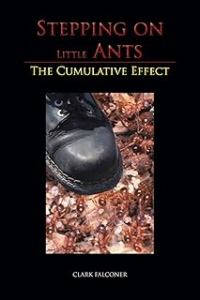
Clark Falconer – The Cumulative Effect Trilogy.
Congratulations to Clark Falconer a long-time community member on the publication of the first edition of his fictional Trilogy: “The Cumulative Effect’ : Volume One, Stepping on Little Ants, Volume Two, The Anteater, and Volume Three, A novella, Wolfey? Available on Amazon now.
A three part story of analysts and generational families struggling with never ending consequences of horrific trauma, in this case following WWII. Clark hopes and believes that the works will be of some keen interest to members.
Congratulations again on the creative work.
The books can be found on Amazon>



THE SÁNDOR FERENCZI CENTER
THE NEW SCHOOL FOR SOCIAL RESEARCH
presents
Selected Papers of the
14th International
Sándor Ferenczi Conference
with presentations by: Jô Gondar, PhD, Daniel Kupermann, PhD, Eugênio Canesin Dal Molin, PhD, Judy Eekhoff, PhD, and Endre Koritar, MD
moderated by
Giselle Galdi, PhD
Saturday, March 7, 2026
12:30 PM to 5:30 PM, Eastern Time
Online via Zoom
General Admission: $50
New School students and current institute candidates: Free
CE Credits (5 hours) available for New York Psychologists, Psychoanalysts, Social Workers, and MHCs APA CE credits also available for Psychologists. Participants must the attend the seminar in its entirety to receive CE creditsFor students and practitioners of all levels
* * *
The title of the São Paulo Sándor Ferenczi Conference was “Psychoanalysis between Catastrophe and Creation: Emerging Perspectives.” The São Paulo Conference, a highly successful event, brought together close to 1,000 clinicians, scholars, researchers, students, and experienced colleagues. The SFC is very pleased to bring the presenters from Rio de Janeiro, São Paulo, Seattle, and Vancouver back together to share their work with our community.
March 7th, 2026, Saturday, 12:30 PM, NY time.
Presenters will meet at 12:15 PM, 15 minutes before the conference starts, to familiarize ourselves with the process.
As the moderator, I will welcome everyone, say a few words about the São Paulo Conference and introduce the presenters to the audience.
There will be 2 panels.
First Panel
Three papers will be presented by our Brazilian colleagues: Jô Gondar, PhD, Rio de Janeiro, Daniel Kupermann, PhD, São Paulo, and Eugênio Dal Molin, PhD, São Paulo.
Topics:
- Jô Gondar, PhD: “With Ferenczi for a Decolonial Psychoanalysis”
- Eugênio Canesin Dal Molin, PhD: “Shock, Resonance, and Creation”
- Daniel Kupermann, PhD: “The Mongrel Complex: Identification with the
- Aggressor, Self-Hatred, versus the Resting Drive (Ruhetrieb)”
Length of presentation time about 25 min each. It is important to keep in mind that each page takes 2.5 minutes to read ALOUD at a good pace. Please format your paper in Times New Roman, size 12, in a double-spaced file. That way, the paper should be about 10 pages to fit into the 25 minutes range. You may have longer papers, which you have prepared for publication in the American Journal of Psychoanalysis. Unfortunately, we will not have the time to read longer papers. If your paper is longer, then it should be shortened for the oral presentation. In the Q & A period, you can add things that you want to convey in addition to the material you presented.
The presentations will be followed by presenters interacting with each other, about 15-20 minutes. Followed by Q & A with the audience, about 30 minutes.
Brief 10 min intermission. Audience and presenters stay logged in.
Second Panel
Papers by Judy Eekhoff, PhD, Seattle, WA., and Endre Koritar, MD, Vancouver, Canada.
- Judy Eekhoff, PhD: “Catastrophe and Creativity: From Fragmentation to Emergence”
- Endre Koritar, MD: “Mother Tongue and the Language of Tenderness: Lost and Found”
Length of presentation time is about 25 min each paper.
The presentation will be followed by presenters interacting with each other, about 15 to 20 minutes. Followed by Q & A with the audience. We can be flexible here, and if we have time we can take questions regarding both panels.
As the moderator, I will keep an eye on the chat box and will either read the question/comments or call on the person to introduce themselves and make the comment/ask their question.
Projected time end of the event: About 5:30 PM, NY time.
More Information at The New School
Memory, Loss, and Legacy:
A Photographic Memory
Directed by Rachel Elizabeth Seed
March 13th, 2026
6:30pm America/Los Angeles
Location:
Online via Zoom (Pacific Time Zone)
CA United States
Event Fee(s):
No fee $0.00
Suggested donation:
General $20.00
Member $10.00
Student $5.00
CE Credits (2) $20.00
Join us for an intimate psychoanalytic conversation as we delve into A Photographic Memory, a poignant and deeply personal documentary by Rachel Elizabeth Seed. The film traces Seed’s journey to uncover the life and legacy of her mother, acclaimed photographer Sheila Turner-Seed, who died when Rachel was just a baby. In A Photographic Memory, Rachel Elizabeth Seed embarks on a journey to know the mother she never had the chance to remember. Her mother, a gifted journalist and photographer, died suddenly when Rachel was just 18 months old. Decades later, Rachel discovers a box of reel-to-reel audio tapes and photographic archives left behind by her mother—interviews with some of the most iconic photographers of the 20th century, including Henri Cartier-Bresson and Bruce Davidson, recorded for a never-completed project in collaboration with The International Center of Photography. Through intimate archival footage, photographs, and voice recordings—alongside Rachel’s own present-day interviews and reflections—the film blurs the lines between past and present, mother and daughter, memory and imagination. It becomes both a detective story and a personal excavation of maternal loss, creative inheritance, and the ways in which we seek connection with those we have lost. Through these archival interviews, photographs, and personal reflections, the film explores intergenerational memory, absence, and the power of visual storytelling in shaping identity and mourning. In this salon, we will examine the film through a psychoanalytic lens, considering themes such as grief, the unconscious transmission of trauma, and the search for symbolic continuity in the face of early loss.
CE Credits offered: 2
Course Objectives
After completing this course participants will be able to:
Using Winnicott’s concept of the loss of the mother, participants will examine how the director’s reconstruction of her mother’s life through photos, interviews, and archives becomes a process of reconstituting her own identity and her connection with her mother.
Participants will Identify and name the links between the aesthetic choices (framing, fragmentation, juxtaposition) and the understanding of unconscious expressions of relational trauma, longing, and repair.
The Psychoanalytic Institute of Northern California (PINC) is approved by the American Psychological Association to sponsor continuing education for psychologists. PINC maintains responsibility for this program and its content. Visit db.pincsf.org/policies for policies and disclaimers.
More Information at PINC

NPSI March Scientific Meeting:
“On Terminating, Ending, and Not Ending”
Presented by Stephen Purcell, MD, FIPA
Wednesday, March 18, 2026
7:00PM – 8:45PM Pacific Time
via Zoom
“As I began to think, self-consciously, about termination, I had the surprising realization that, despite being involved in the endings of many analyses, I did not know with clarity or in any theoretical detail how I thought about the subject.” So begins Stephen Purcell, with characteristic humility, his exploration of analytic termination—a dimension of psychoanalysis with which Sigmund Freud (1937) himself famously struggled in Analysis Terminable and Interminable.
Stephen Purcell presents his paper, “On Terminating, Ending, and Not Ending.” He reflects on formative experiences with analytic terminations, including the first termination he was involved in when he was a candidate, and offers tentative conclusions about two principles that appear central to all terminations. He also addresses some of the complexities of ending very long analyses; mechanisms by which an analyst’s theory may shape the phenomena of termination; how we might understand themes of death in termination; the enduring questions surrounding post-termination contact between analysts and their patients—raising, finally, the related issue of whether analytic relationships ever can, or should, ever truly be ended.
Learning Objectives:
1. Specify processes by which some phenomena of termination might be shaped by the analyst’s theory.
2. Recognize aspects of termination that are complicated by a patient’s history of trauma.
3. Understand themes of “death” in termination processes as having multiple underlying sources.
General Public: $65 USD
NPSI Members: $50 USD
Analysts-in-Training from other institutes (validation required): $15 USD
NPSI Analysts-in-Training: $5 USD
Continuing Education Credits – 1.75 hours

NAPsaC announcing a series of presentations coming up…
Four Social Dreaming Matrices: Connecting Through the Roots of Our Present Social Unconscious
Consultants: Carlos Remotti-Breton, Maria Pia Conte and Irene Cappelli
February 21, 28, and March 7 and 14
11:30am – 1:00pm EST (via Zoom)
Held on 4 consecutive Saturdays
Love in the Plural: Psychoanalytic Dialogues on Polyamory
Presenters: Magdalene J.Fosse and Edie Hitchcock
Discussant: Shelley Nathans
March 21, 2026
11:30am – 3:00pm EST (via Zoom)
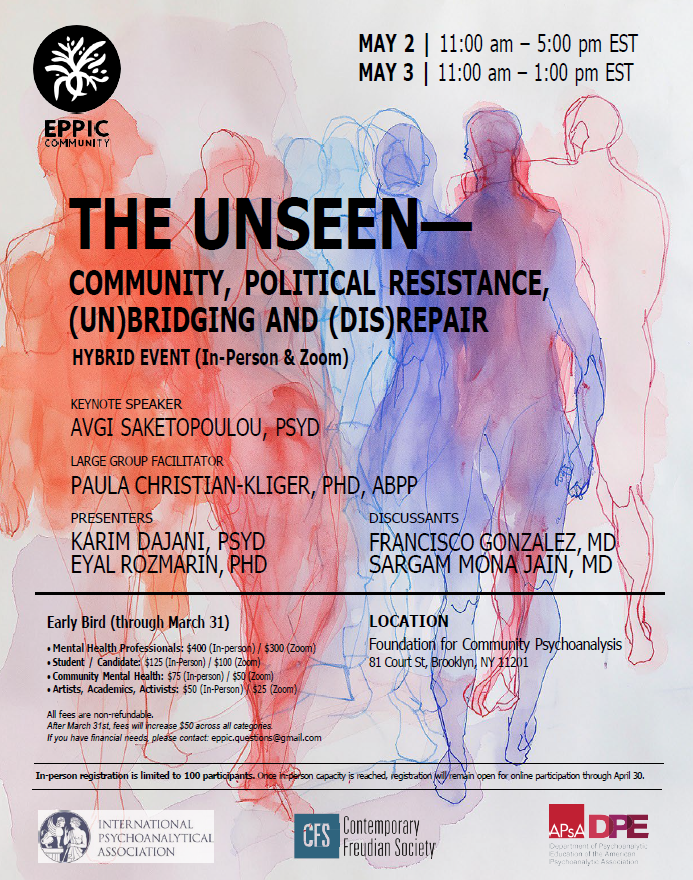
The Unseen – Community, Political Resistance,
(Un)Bridging, and (Dis)Repair
May 2 & 3, 2026
Study Groups
Study Groups – TBD
If you wish to share your events with WCPSI please email info@wcpsi.org.